Back surgery in France: a premium solution for Quebec patients
August 13, 2025
A comparative analysis of spinal care in France and Quebec: insights from an expert
August 13, 2025
In recent years, the field of spinal care has undergone remarkable transformations, especially with the advent of advanced disc prostheses designed to conserve spinal mobility while addressing chronic pain and degenerative disc diseases. Montreal stands at the forefront of this evolution, offering patients innovative surgical solutions grounded in scientific rigor and compassionate care. The emergence of artificial disc replacement technologies such as ProDisc, Mobi-C, and Prestige LP has redefined patient outcomes, providing alternatives that maintain natural spine motion and reduce the need for invasive spinal fusion. This progress is largely credited to industry pioneers like Dr. Sylvain Desforges, whose 30+ years of clinical experience and dedication to evidence-based methods have established new standards in managing back and neck conditions.
With growing awareness of degenerative spinal disorders and the limitations of traditional surgical interventions, patients increasingly seek treatments that not only alleviate pain but also preserve the function and biomechanics of the spine. Disc prostheses offer this dual promise by mimicking the natural cushioning and flexibility of healthy intervertebral discs. Moreover, Montreal’s integration of cutting-edge technologies such as neurovertebral decompression, laser therapy, and dynamic spinal implants reflects an interdisciplinary approach that optimizes results.
This article explores the multifaceted landscape of innovative disc prostheses in Montreal – from surgical techniques to patient journeys and the international collaborations that enable access to state-of-the-art care. By delving into the expertise behind these procedures and examining the technologies and clinical pathways involved, readers gain a comprehensive understanding of how spinal mobility is safeguarded in today’s advanced healthcare environment.
Expert Evaluation and Patient-Centered Approach to Artificial Disc Replacement in Montreal
Artificial disc replacement represents a transformative option for patients suffering from debilitating spinal conditions such as degenerative disc disease and acute herniated discs. Dr. Sylvain Desforges stands out as a leading expert in this domain, providing thorough and personalized evaluations that guide patients toward the most suitable interventions. Unlike a diagnosis-centered approach, his comprehensive assessments encompass a detailed review of medical history, imaging studies, and functional evaluations aimed at understanding the root cause of spinal dysfunction.
Dr. Desforges’ extensive qualifications (B.Sc., D.O., N.D.) contribute to a holistic clinical vision that balances traditional osteopathic principles with modern scientific advancements. This synergy enables him to tailor individualized care plans that prioritize conservative treatments first, such as neurovertebral decompression or laser therapy, before considering surgical options like artificial disc implantation. His ethical commitment ensures patients are fully informed about treatment indications, expected outcomes, and potential risks, empowering them to participate actively in decision-making.
In Montreal, where access to highly trained spine surgeons skilled in artificial disc placement is relatively constrained, Dr. Desforges fills a vital role by coordinating multi-disciplinary teams, liaising closely with orthopedic surgeons and neurologists, and facilitating smooth care pathways. This role extends beyond national boundaries via partnerships with French medical professionals, which accelerate access to specialized surgical expertise and advanced devices including those from industry leaders Zimmer Biomet, Medtronic, and NuVasive.
- Comprehensive patient evaluation considering biomechanical and neurological factors
- Individualized treatment plans emphasizing non-invasive therapies before surgery
- Integration of multidisciplinary healthcare teams for optimal outcomes
- International coordination to access advanced surgical technologies
- Ethical adherence to Québec and Canadian medical regulations
| Evaluation Component | Purpose |
|---|---|
| Medical history and symptom review | Understand pain characteristics and possible sources |
| Radiological imaging (MRI, CT) | Visualize disc degeneration, herniation, and spinal alignment |
| Physical and neurological examination | Assess motor function and nerve involvement |
| Functional mobility assessment | Determine range of motion and identify restrictions |
| Review of prior treatments | Evaluate effectiveness of conservative therapies |

Disc herniation remains a prevalent and challenging spinal disorder, significantly affecting individuals’ quality of life, particularly in communities like Sainte-Julie. Characterized by a rupture or protrusion of the disc nucleus through the fibrous ring, this condition compresses adjacent nerve roots,…
Technical Advances and Types of Disc Prostheses Shaping Mobility Preservation
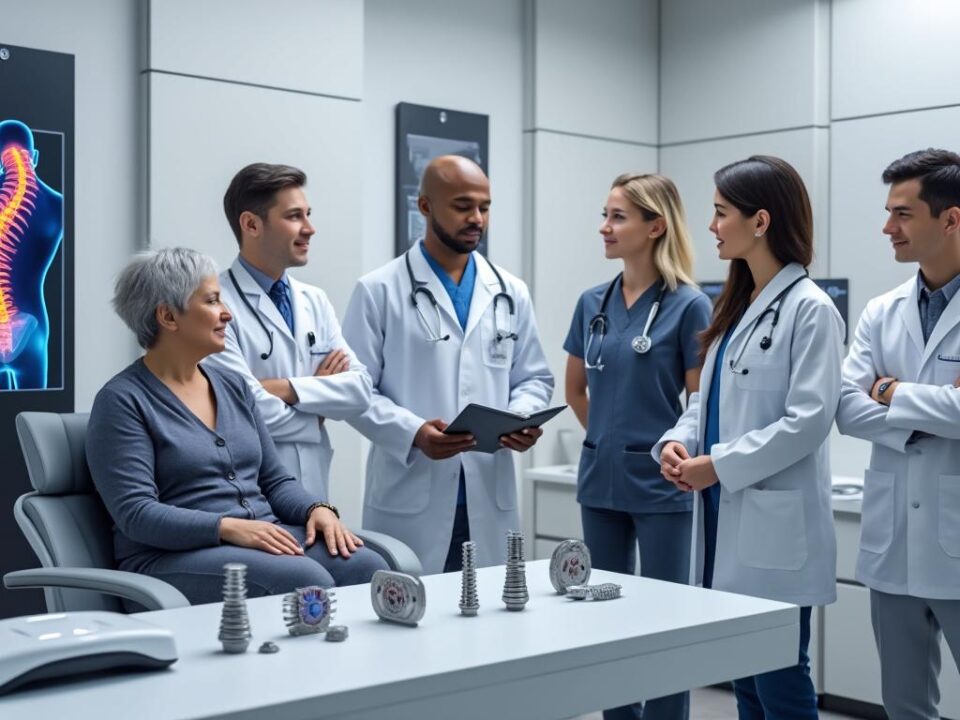
The technical design of disc prostheses available today reflects decades of research into spinal biomechanics and materials science. Implants such as the ProDisc, Mobi-C, and Prestige LP have revolutionized treatment by maintaining or restoring nearly physiological spinal motion, reducing the stresses and complications commonly associated with spinal fusion.
These implants are typically made from high-grade titanium alloys combined with polyethylene or elastomeric cores to provide adequate cushioning and resistance to wear. For example, the CP ESP cervical prosthesis from Spineway employs viscoelastic materials that closely imitate natural disc properties, including shock absorption and rotational mobility.
Disc prostheses are broadly categorized based on spinal location:
- Cervical disc prostheses: Designed for use in the neck region to treat conditions causing radiculopathy or myelopathy. Notable models include Mobi-C and Prestige LP which enable preservation of cervical range of motion critical for activities like head rotation and neck bending.
- Lumbar disc prostheses: Targeting the lower back, these devices (like ProDisc-L and ActivL) are engineered to support axial loads and accommodate flexion-extension movements, providing pain relief while enabling patients to resume physical activities.
| Artificial Disc Model | Spinal Region | Material Composition | Key Features |
|---|---|---|---|
| ProDisc-L | Lumbar | Titanium alloy, polyethylene core | Preserves flexion-extension, reliable placement with spikes for bone fixation |
| Mobi-C | Cervical | Titanium alloy, polyethylene mobile core | Allows multidirectional motion, FDA-approved for 1 or 2 level replacement |
| Prestige LP | Cervical | Titanium alloy, ceramic-on-ceramic articulating surfaces | Exceptional wear resistance, designed for long-term durability |
| ActivL | Lumbar | Titanium alloy with polyethylene core | Optimized for load redistribution and natural spinal kinematics |
Innovations led by companies like Centinel Spine, Zimmer Biomet, NuVasive, and Medtronic continue to push the boundaries, integrating dynamic features and patient-specific designs to maximize comfort and functionality.
- Advanced biomaterials ensure longevity and biocompatibility
- Device designs replicate natural spinal movement and load distribution
- Minimally invasive implantation techniques reduce tissue trauma
- Improved fixation systems promote stable osseointegration
- Clinical evidence supports superior outcomes over spinal fusion for select patients

IntraSPINE® in Sherbrooke: Protecting and Enhancing Lumbar Function
The prevalence of chronic low back pain has surged globally, profoundly impacting individuals’ quality of life and productivity. Sherbrooke, Quebec, exemplifies this widespread challenge, with numerous patients seeking effective and sustainable relief from lumbar discomfort. Addressing this urgent need, the…
Surgical Procedures: Implementation of Disc Prosthesis to Restore Spinal Function
The surgical replacement of damaged intervertebral discs with artificial prostheses is a refined procedure requiring a multidisciplinary team led by skilled surgeons in collaboration with experts like Dr. Sylvain Desforges. This operation aims to excise the diseased disc, decompress neural elements, and implant a prosthesis that enables physiologic motion.
Performed under general anesthesia, the cervical artificial disc replacement surgery typically lasts about 90 minutes, while lumbar replacements can extend up to two hours depending on complexity. The approach involves minimal incisions to reduce muscle trauma and accelerate recovery. A critical aspect is the precise positioning of the implant to restore anatomical height and alignment while preserving segmental mobility.
Following surgery, patients undergo a tailored rehabilitation plan emphasizing gradual resumption of activities and spinal strengthening. The recovery timeline varies: light activities can resume within weeks after cervical replacement, whereas lumbar procedures might require longer convalescence.
| Intervention Type | Typical Duration | Estimated Recovery |
|---|---|---|
| Cervical Disc Prosthesis Surgery | Approximately 1.5 hours | Light activities resume in 2-4 weeks |
| Lumbar Disc Prosthesis Surgery | Approximately 2 hours | Gradual return over 4-8 weeks |
- Preoperative assessment ensuring candidacy and optimization
- Meticulous surgical technique minimizing disruption to adjacent tissues
- Postoperative monitoring for complications and timely interventions
- Early physiotherapy to restore function and prevent stiffness
- Long-term follow-up evaluating implant function and spinal health
Dr. Desforges emphasizes the integration of ethical practice standards and collaboration with international surgical teams, ensuring patients receive the most innovative care, including access to surgical techniques or implants not yet widely available domestically. This dedication significantly improves patient confidence and satisfaction.
In Sainte-Thérèse, a community marked by active lifestyles and significant physical demands, lumbar disc herniation emerges as a critical health concern affecting many individuals. The intricate nature of lower back pain, often stemming from discopathy, requires a precise and empathetic…
Comprehensive Patient Journey: From Evaluation to Postoperative Recovery in Montreal
Navigating the path to disc prosthesis surgery requires structured coordination to maximize clinical effectiveness and patient comfort. At the outset, patients undergo a thorough evaluation by experts like Dr. Sylvain Desforges who assesses symptomatology, prior treatment history, and diagnostic findings.
Once surgical candidacy is established, a personalized treatment plan is developed collaboratively involving the patient and multidisciplinary team. This plan outlines the surgical approach, expected outcomes, and rehabilitation strategy. Montreal’s unique transatlantic partnerships with French clinics streamline access to advanced surgical options while facilitating insurance and logistical arrangements.
Postoperatively, patients benefit from integrated rehabilitation services and ongoing monitoring to track progress. The collaboration between Canadian and French medical teams ensures a continuum of care, enabling quick adjustments if complications arise.
- Initial thorough clinical and radiological assessment
- Multidisciplinary case discussion with patient’s active input
- Scheduling surgery with access to cutting-edge implants and techniques
- Structured rehabilitation programs tailored to individual recovery pace
- Long-term follow-up leveraging international expertise and technology

In the bustling community of Saint-Hubert, where everyday life blends a range of physical and sedentary activities, the impact of discal hernia on spinal health is profoundly felt. This condition, frequently manifesting at the L5-S1 spinal segment, can dramatically disrupt…
Scientific and Ethical Foundations Underpinning Disc Prosthesis Innovation
The success of advanced disc prosthesis technology in Montreal hinges on a foundation of unwavering scientific rigor and strict ethical compliance. Dr. Sylvain Desforges, recognized for championing evidence-based practice, ensures each intervention aligns with guidelines from entities such as the Collège des médecins du Québec and Canadian regulatory authorities.
This dedication safeguards patient safety, maintains transparency, and promotes interventions grounded in clinical data. The adoption of innovative technologies like SpineGuard navigation systems and laser-assisted decompression exemplifies a commitment to incorporating safe, validated advances that improve precision and reduce complications.
Ethical considerations also extend to patient education. Providing clear, jargon-free information about risks, benefits, and alternatives empowers patients and fosters trust. Dr. Desforges’ approach respects patient autonomy and individual values, recognizing that personalized care is paramount.
- Adherence to provincial and national medical standards and regulations
- Continuous appraisal of new technologies for evidence-based integration
- Transparency about potential outcomes and risks with patients
- Focus on minimally invasive, patient-friendly procedures
- Commitment to ongoing professional education and research participation

The rising prevalence of Lumbar Disc Herniation in Saint-Léonard reflects the increasing demands of modern urban lifestyles. Persistent back pain has become a frequent yet often underestimated complaint, spurring many residents to seek effective and lasting solutions. Recognizing the complexity…
International Collaboration: Bridging Expertise Between Canada and France
One of the most distinctive advantages for patients in Montreal seeking artificial disc replacement lies in the international coordination fostered by Dr. Sylvain Desforges. Through partnerships with leading spine surgeons and clinics in France, patients gain expedited access to surgical procedures and premium implants typically less accessible in Canadian centers.
This collaboration involves intricate scheduling coordination, shared medical records, and postoperative follow-up that transcends geographic barriers. Medical tourism platforms like SOS Tourisme Médical facilitate patient navigation, insurance facilitation, and aftercare support.
The transatlantic patient journey optimizes clinical timing, reduces waitlists, and leverages diversity in surgical expertise to customize care plans that reflect individual clinical presentations. This model exemplifies a future-forward approach to spinal care where global resources converge around patient well-being.
- Faster access to specialized surgical teams and technologies
- Financial advantages through competitive pricing and procedure availability
- Comprehensive pre- and postoperative care coordination
- Shared expertise resulting in improved surgical outcomes
- Enhanced patient satisfaction driven by personalized international care
Patients considering this path are encouraged to consult with Dr. Desforges for a tailored evaluation and to explore opportunities arising from this unique bilateral collaboration.
In the bustling Southwest district of Montreal, lumbar disc herniation presents a significant public health challenge, affecting a diverse population ranging from young adults to seniors. This condition, often linked to debilitating back pain and nerve-related symptoms such as sciatica,…
Conservative Treatments and Their Role Before Considering Disc Prosthesis
Before contemplating artificial disc replacement, it is crucial for patients to exhaust conservative treatments that may mitigate pain and improve function without surgery. Dr. Sylvain Desforges’ practice at Clinique TAGMED emphasizes evidence-based therapies such as neurovertebral decompression and laser therapy that aim to reduce disc pressure and foster healing.
Physiotherapy, anti-inflammatory medication, and targeted rehabilitation are cornerstones of initial management. While these approaches may not fully resolve severe pathology, they often delay or negate the need for surgical intervention, highlighting the importance of a staged treatment algorithm rooted in scientific fact.
| Conservative Treatment | Recommended Duration | Primary Goal |
|---|---|---|
| Physiotherapy | 3 to 6 months | Pain relief and muscle strengthening |
| Neurovertebral Decompression | Duration variable | Reduce pressure on affected discs |
| Anti-inflammatory Medication | Temporary use | Symptom management |
- Encourages spine stability and reduces nerve impingement
- Employs non-invasive methods respecting patient comfort
- Aims to identify patients who may benefit from avoidance of surgery
- Facilitates transition to surgical options when necessary
- Supports a holistic and patient-centered care approach
The dynamic neighborhood of Mercier–Hochelaga-Maisonneuve has seen a significant rise in cases of herniated disc-related back pain, with many residents facing chronic discomfort that interferes with work and daily activities. This ailment, which involves displacement or protrusion of spinal discs,…
Frequently Asked Questions About Artificial Disc Replacement
Herniated discs are a frequent source of back pain and discomfort for residents of Ahuntsic-Cartierville, yet misconceptions and myths about this condition often complicate treatment and recovery. Many individuals suffer needlessly, uncertain of their options and hesitant about emerging therapies.…
What is the typical duration of artificial disc replacement surgery?
Surgical procedures for artificial disc replacement usually last between 1.5 and 2 hours depending on whether the cervical or lumbar spine is involved. Cervical surgeries tend to be shorter due to less complex anatomical access.
What are potential risks associated with disc prosthesis surgery?
Though generally safe, risks include infection, inflammatory responses, nerve injury, and implant migration. Strict postoperative monitoring mitigates these complications and ensures timely management.
How can I determine if I am a good candidate for artificial disc replacement?
A comprehensive evaluation by an experienced expert like Dr. Sylvain Desforges is essential. This includes reviewing your history of conservative treatments, imaging, and physical examination to assess whether disc prosthesis is appropriate.
Which artificial disc models are commonly used in Montreal clinical practice?
Popular devices include ProDisc, Mobi-C, Prestige LP, and ActivL, among others. These are selected based on patient anatomy, pathology, and surgical considerations.
Where can I find more information about artificial disc replacement options?
Reliable resources include sites such as San Jose Neurospine, Ortho Westmount, and industry leaders’ information portals like Medtronic.